Build vs. Buy AI Agents: When to Use a Managed Agent
Should you build an AI agent, buy a platform, or use a managed agent? Compare cost, control, speed, expertise, and ongoing ownership.
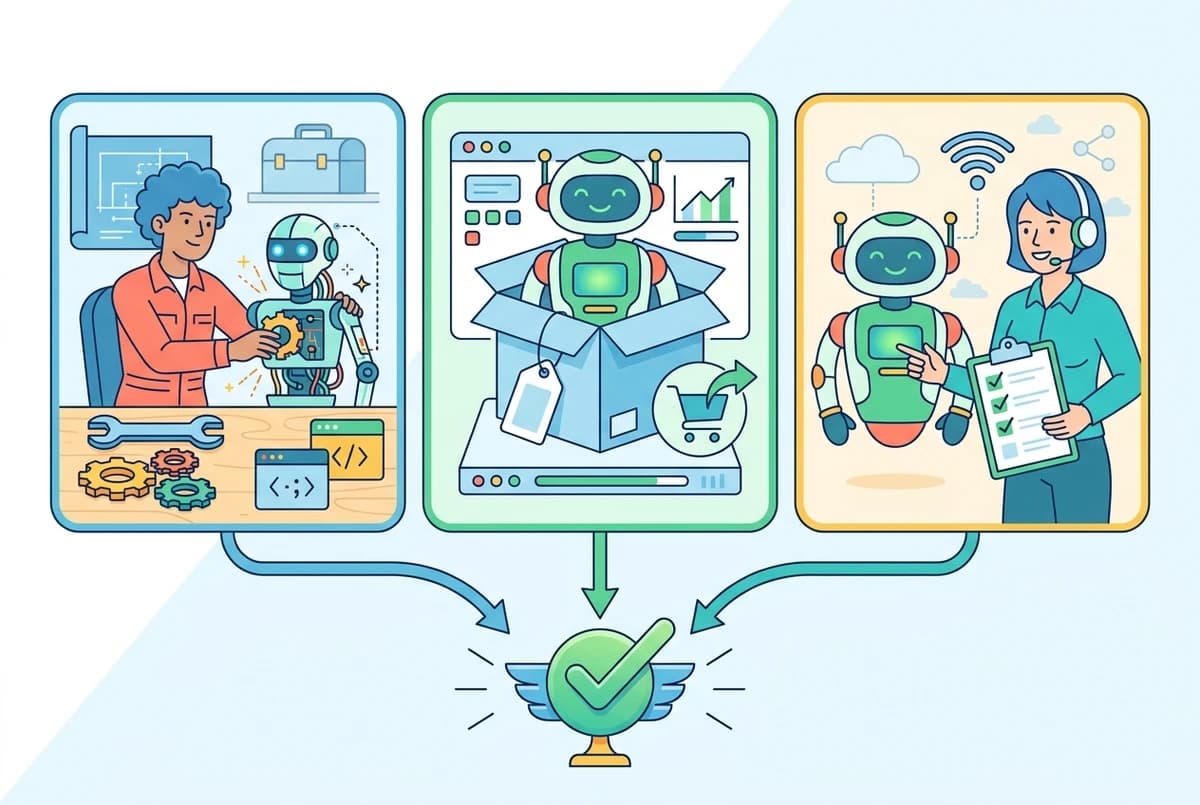
A growing company builds a quick AI agent demo for a repetitive workflow. It reads the right files, updates the right system, and finishes in minutes.
Then harder questions appear. Who connects it to production systems? Who tests exceptions, monitors failures, and updates it when the process changes? Who remains responsible for the outcome?
Choosing whether to build an AI agent, buy an AI agent platform, or use a managed agent is not only about who creates it. It is about who owns the workflow after launch.
There is no universally right model. Each trades control, speed, internal effort, and ongoing responsibility differently.
What do build, buy, and managed actually mean?
The three options can use similar models and integrations. The difference is where the work—and ownership—sits.
| Build internally | Buy a platform | Use a managed agent | |
|---|---|---|---|
| Initial setup | Designed and developed by your team | Configured by your team | Adapted with expert support |
| Internal expertise | High | Medium | Low to medium |
| Time to first outcome | Usually longest | Fast for standard workflows | Fast for specific workflows |
| Customization | Highest | Depends on the platform | Adapted to the workflow |
| Ongoing monitoring | Your team | Primarily your team | Shared or provider-led |
| Best fit | Strategic, proprietary systems | Standard, bounded processes | Complex operations without an agent team |
Build gives you the most technical ownership. Buy removes much of the infrastructure work. Managed removes much of the implementation and operational burden.
This distinction is important for companies with 25 to 200 employees. Their workflows already cross inboxes, spreadsheets, internal systems, and departments, but they rarely have an AI engineering team waiting to maintain another production system. A fast setup is useful only if somebody can own what comes next.
The four questions that decide which model fits
1. Is the workflow a competitive advantage?
Building is easiest to justify when the workflow contains proprietary logic that differentiates your company. If an agent powers a core product capability or uses unique internal data defensibly, technical ownership may be worth the investment.
Many operational workflows are important without being differentiating. Matching invoices, updating a CRM, or preparing routine reports must be done well, but owning the agent code may create little advantage.
Build what differentiates your business. Be careful about building permanent infrastructure around work that simply needs to get done.
A standard process with clear inputs and supported integrations may fit a self-service platform perfectly.
2. Who will own the agent after launch?
Every production agent needs a named owner for outcomes, exceptions, permissions, instruction changes, and performance.
Buying can look simpler than it is. A platform removes core infrastructure work, but your team still configures the workflow, tests cases, reviews runs, diagnoses failures, and updates it as the business changes.
“If operations will manage it” is not a complete answer. Identify the person, then ask what part of their existing job will make room for it.
A managed agent shifts more work to a provider, but your company still owns policies, access decisions, escalation rules, and the definition of success.
3. How messy is the real workflow?
The clean process is rarely the expensive part. Difficulty lives in an unexpected attachment, a customer name that differs between systems, an approval sent through the wrong channel, or a judgment call known by one employee.
Count the systems, unstructured inputs, exceptions, approvals, sensitive actions, and undocumented knowledge. The more a workflow contains, the less likely a generic template will survive unchanged.
Predictable workflows favor self-service platforms. Cross-system workflows with frequent exceptions make expert adaptation more valuable. We explore this gap in moving an AI agent from demo to production.
4. How quickly must the outcome exist?
Speed to demo and speed to dependable value are different measurements.
Building gives you the greatest control, but your team must maintain integrations, permissions, evaluations, monitoring, and recovery. Buying can be fastest when a platform already fits and an internal owner is ready.
Managed deployment makes sense when urgency and workflow specificity are both high, but assembling an internal agent team would delay the outcome.
The fastest option is not the one that produces the earliest demo. It is the one that reaches a dependable outcome with the least organizational drag.
One workflow under all three models
Consider accounts payable coordination: collect incoming invoices, match them to purchase orders, request missing information, and route unresolved exceptions to Finance.
Build internally
Your team creates document processing, approval routing, integrations, credential handling, exception logic, monitoring, and a review interface. This fits a strategically important, proprietary process backed by engineering capacity.
Buy an AI agent platform
Your operations team connects systems, writes instructions, tests cases, reviews runs, and maintains the workflow. This fits a reasonably standard process, supported integrations, and a capable internal owner.
Use a managed AI agent
The provider maps the process, connects systems, configures permissions and approvals, tests historical cases, launches the workflow, and helps improve exceptions. This fits when the result matters but agent infrastructure is not a core competency.
The outcome is the same. What changes is who absorbs implementation and keeps the workflow dependable.
How to make the decision now
1. Define one verifiable outcome
Avoid “automate finance.” Use a result a person can inspect, such as: collect missing invoice information, match it against purchase orders, and route unresolved items to Finance.
2. Map the real workflow
Document the systems, people, inputs, approvals, exceptions, and sensitive actions. Include the awkward path employees handle from experience, not only the official process diagram.
3. Name the post-launch owner
Decide who reviews performance, handles escalations, approves changes, and determines when the agent receives more responsibility. Do this before choosing a product or provider.
4. Compare first-year ownership cost
A license price and a development estimate are not comparable on their own.
First-year cost = implementation + software + integrations + internal time + monitoring + exception handling + maintenance
The cheapest setup can become the most expensive option if it quietly consumes engineering or operations time every week.
Build, buy, or managed checklist
Build when:
- The workflow is strategically differentiating
- You have available engineering capacity
- Deep technical control is necessary
- Your team can maintain the system long-term
Buy a platform when:
- The workflow is relatively standard
- Existing integrations cover most requirements
- You have an internal configuration owner
- Your team wants direct operational control
Use a managed agent when:
- The outcome matters, but agent development is not a core competency
- The workflow crosses systems, channels, or departments
- Real cases contain frequent exceptions
- You want help launching, monitoring, and improving it
If nobody can own the business outcome internally, none of the three models will work well. Managed support reduces implementation burden; it does not outsource accountability.
Why Communa supports both paths
We built Communa around a lesson that applies to every model: launching an agent is only the beginning. The workflow still needs clear ownership, controlled access, visible execution, human approvals, and a safe way to improve over time.
Some teams want a platform they can operate themselves. Others know the outcome they need but do not want to create an internal agent team around it. Communa supports both: a collaborative platform for building and operating agents, and Managed Agents adapted around a company's workflow, systems, rules, and team.
If you have a workflow in mind but are unsure which model fits, show us how it works today. We can help you evaluate the ownership requirements before you commit to an approach.
Three practical questions
Is it cheaper to build or buy an AI agent?
It depends on the workflow and your existing capacity. Building includes engineering, infrastructure, testing, security, monitoring, and maintenance. Buying reduces development work but still requires configuration and operational ownership. Compare first-year total ownership cost, not only development estimates or subscription prices.
What is the difference between an AI agent platform and a managed agent?
A platform provides software for your team to configure and operate. A managed agent includes expert support for adapting the workflow, connecting systems, testing real scenarios, launching it, monitoring performance, and improving exceptions after launch.
When should a business use a managed AI agent?
A managed agent is strongest when the desired outcome is clear, the workflow crosses systems or teams, exceptions are common, and the company does not want to build a dedicated internal agent function.
Building asks: do you want to own the system?
Buying asks: can your team operate the system?
Managed asks: do you want expert help delivering and maintaining the outcome?
The right choice is not the option with the most AI. It is the option that gives the workflow a clear owner after the demo is over.