From AI Agent Demo to Production: What We Learned the Hard Way
Moving an AI agent from demo to production takes more than a good prompt. Our team shares four practical lessons from building Communa.
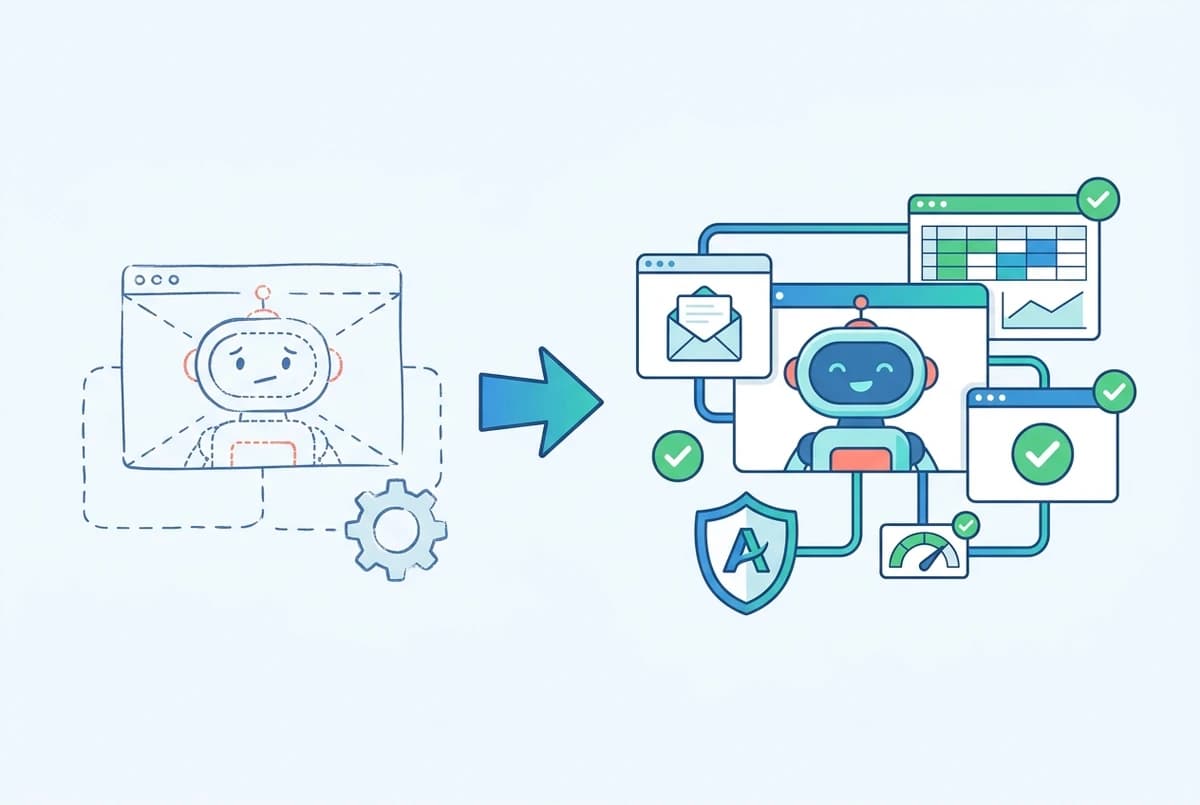
The first time an agent completes a real workflow, it feels like the hard part is over. We thought so too.
Then the browser closes. A login expires. An attachment arrives in the wrong format. A teammate changes the instructions. The agent says it finished, but nobody can tell whether the business outcome was actually correct.
That is when a demo becomes a production problem.
Moving an AI agent from demo to production means making it reliable when inputs are messy, work is interrupted, sensitive systems are involved, and nobody is watching. In practice, that requires durable execution, controlled access, human escalation, and a clear record of what happened.
Our product and engineering team has spent the last few years working through that gap while building Communa. We got some of our early assumptions wrong—especially the idea that more autonomy would automatically create more trust. These are the four lessons we keep coming back to.
What changes between an AI agent demo and production?
A demo is designed to show what is possible. Production has to handle what is normal: incomplete information, unreliable software, competing instructions, and people who have other work to do.
| In a demo | In production |
|---|---|
| Clean examples | Missing, inconsistent, changing inputs |
| Someone watches every step | Work runs while the team is elsewhere |
| A failure can be retried by hand | Failures must be detected and recovered |
| One builder controls everything | A team needs roles and visibility |
| “It finished” sounds good enough | The business outcome must be correct |
A demo proves capability. Production has to earn trust.
This matters most in companies with 25 to 200 employees. The workflows are already complex enough to cross departments and systems, but there usually is not an internal team waiting to build and maintain AI infrastructure for every process. The agent has to fit the business, not create a second business to manage it.
The four things production forced us to solve
1. Real work is messier than test data
The happy path is seductive. Five invoices arrive in the expected format. The fields are present. The supplier names match. The demo works.
The eleventh invoice is where production starts. The purchase order is missing. The supplier uses a different legal name. The attachment is a photo. The finance lead knows what to do because she has seen it before, but none of that judgment appears in the written process.
We stopped asking whether an agent could complete the clean example. We started asking what it would do with the awkward case that everyone quietly handles by hand.
Our answer is not to write an enormous prompt that predicts every exception. It is to define one clear outcome, give the agent the context it actually needs, and give it a sensible way to ask for help. That is why we recommend starting with a minimum viable outcome, not a plan to automate an entire department.
2. Work has to survive real life
A production task cannot depend on somebody keeping a tab open. People close laptops, change networks, enter meetings, and go home. Third-party systems time out. Jobs that look short sometimes take an hour.
One of our most important product decisions was separating the work from the window used to watch it. Closing Communa should close the view, not cancel the job.
That sounds obvious now. It was not obvious when we started. It required persistent workspaces, durable state, explicit cancellation, and recovery when a process disappears halfway through a task.
We wrote a deeper technical explanation of how long-running AI agents continue and recover. The business version is simpler: if a dropped connection can throw away the work, you have a demo with good Wi-Fi requirements.
3. Access needs boundaries
Useful agents need access. They may need to open a shared inbox, update a CRM, work inside a vendor portal, or read a financial document.
But handing an agent every password and hoping the prompt keeps it in line is not a security model.
We use the same mental model we would use for a new employee: give the agent the access required for its role, keep raw secrets out of its view, separate its workspace from unrelated work, and require approval before sensitive or irreversible actions.
For an operations team, this is less about security jargon and more about a basic question: if this workflow does the wrong thing, how far can the mistake travel? Production access should keep the answer small.
4. Teams need receipts, not more autonomy
Early on, we assumed that better autonomy would create trust. In practice, visibility mattered first.
When an agent finishes, your team needs plain answers. What did it do? Did the task merely complete, or did it produce the right outcome? What did it cost? Where did it deviate? Who changed its instructions? Can that change be reversed?
We learned that trust does not come from hiding the messy parts. It comes from making them visible and recoverable.
That is why Communa treats each run and each change as a record your team can inspect later. It is also why we built change history and revert into the product. When several people can improve an agent—or the agent can improve its own skills—“who changed what?” should take seconds to answer, not a day of Slack archaeology.
We explore that idea in more detail in what your AI agent does while you are not looking.
How we move a workflow into production now
Our process is intentionally unexciting.
1. Pick one outcome
Not “automate finance.” Pick something a person can verify, such as: match incoming invoices to purchase orders and route mismatches to the finance lead.
2. Test real cases
Use historical work, including the failures, odd formats, and exceptions. Five polished samples tell you almost nothing about production.
3. Run with supervision
Let the agent prepare the work while a person reviews sensitive actions. Keep the review step until you understand where the workflow breaks and how often it needs help.
4. Expand when it becomes boring
Add volume, schedules, or more autonomy after the outcome is predictable—not after the demo gets applause.
Our rule now is simple: do not scale an agent because the demo was impressive. Scale it when the workflow has become boring.
Is your AI agent ready for production?
Before giving an agent more responsibility, we ask seven questions:
- Does one person own the business outcome?
- Can you tell the difference between “completed” and “successful”?
- Does the work continue safely after a disconnection?
- Can the agent recover or escalate when something fails?
- Are credentials and permissions properly scoped?
- Can your team see what happened and who changed what?
- Can a person stop, review, or reverse sensitive actions?
If several answers are “not yet,” the agent is still a pilot. That is not a failure. Finding those gaps is the purpose of a pilot.
Why we built Communa this way
These lessons became product decisions.
Agents have persistent workspaces because real jobs outlive browser sessions. Credentials are scoped because useful agents need access without being handed raw secrets. Runs and changes are visible because teams need to understand what happened. Approvals and reverts exist because autonomy without recovery is difficult to trust.
We did not build Communa to make an agent look impressive once. We built it so a growing business can depend on that agent every day.
If you have a workflow that works in a demo but still feels risky in production, we would be glad to compare notes.
Three practical questions
What makes an AI agent production-ready?
A production-ready AI agent can complete a defined business outcome reliably, use systems and credentials within clear boundaries, continue or recover after interruptions, escalate exceptions to a person, and show your team what happened. Production readiness is operational trust, not a perfect prompt.
How should a growing business deploy its first AI agent?
Start with one measurable workflow and test it against real historical cases. Run it under human supervision, track successful outcomes rather than completed runs, and increase autonomy only after the common failures and exceptions are understood.
How much human oversight does a production AI agent need?
Oversight should match the risk and reversibility of the action. Low-risk, reversible work can run with more autonomy. Financial, customer-facing, or difficult-to-reverse actions should include approval or a clear escalation path.
A demo asks: can the agent do this?
Production asks: can our team trust it to do this repeatedly, securely, and without someone watching every step?
That second question is harder. It is also where the real business value begins.